



For much of the last three decades, many market shocks occurred against a relatively consistent backdrop. Inflation was generally low and stable, globalisation supported growth and disinflation, and diversified portfolios could often rely on bonds providing ballast when equity markets came under pressure.
Today, the backdrop itself is becoming a source of uncertainty.
Advisers are now navigating an environment where economic cycles, geopolitics, technology, demographics and policy decisions are increasingly intertwined, leading to a much broader range of potential outcomes than investors have become accustomed to.
The implication is profound: portfolio resilience is no longer simply about protecting capital in difficult periods. Increasingly, it is becoming a source of return in its own right.
The market has been resilient, but the starting point has changed
Recent market performance has been remarkably strong despite persistent geopolitical uncertainty and inflation concerns.
According to Mason Stevens’ OCIO analysis, the S&P 500 price index 20.9% over the previous 12 months, while the ASX 200 price index rose 2.8%, demonstrating the continuing strength of corporate earnings especially in the US, resilient labour market and positive investor sentiment.¹
Yet advisers should distinguish between strong historical returns and future opportunity.
Key market supports remain:
- US corporate earnings growth remains strong and margins near record levels.
- AI-related capital expenditure is broadening beyond mega-cap technology.
- Labour markets remain relatively resilient.
- Energy prices have moderated from their peaks.
At the same time, there are some headwinds:
- Equity risk premia are compressed, with thin compensation for risk.
- Core inflation has proven more persistent than expected.
- Central bank policy is no longer an obvious source of support.
- Geopolitical risks have diminished from crisis levels but remain elevated.
In other words, returns have been earned. The margin for error has narrowed.
Why market shocks recover faster than before
One of the most interesting observations from recent decades is not that shocks occur more frequently, but that markets increasingly recover from them faster.
Analysis shows that four of the five fastest MSCI World recoveries from significant drawdowns have occurred since 1998.¹

Source: Mason Stevens OCIO, T.Rowe Price
Several structural factors help explain this phenomenon:
1. Faster policy responses
Central banks and governments now tend to respond more rapidly and aggressively to periods of financial stress than in previous cycles.
2. Market structure has evolved
Index strategies, systematic funds and algorithmic allocation models can mechanically redeploy capital into markets following dislocations, supporting recoveries.
3. Longer-term investor behaviour
Both institutional investors and corporates increasingly focus on long-term earnings growth rather than reacting solely to short-term market events.
However, advisers should avoid assuming every future shock will follow the same pattern.
The speed of recovery from recent drawdowns does not guarantee that future corrections will behave similarly, particularly when structural supply-side constraints are increasingly influencing economic outcomes.
The real shift: demand no longer drives everything
Perhaps one of the most important investment theme today is that the global economy is no longer dominated solely by demand-driven cycles.
From roughly 1990 to 2021, supply was generally abundant:
- Global labour costs fell.
- Energy remained broadly accessible.
- Global supply chains expanded.
- Just-in-time manufacturing increased efficiency.
With those forces pulling the same way, supply rarely forced itself into the story. Prior to Covid, the economy’s ups and downs came mostly from the demand side and shifts in policy – and that is what shaped the relationship between growth and inflation. Because demand was usually the factor doing the moving, growth and inflation tended to ebb and flow in a similar rhythm – a stronger economy nudged prices up, a weaker one let them cool.
Today, that backgdrop can no longer be taken for granted; supply itself is becoming volatile.
Tariffs, reshoring initiatives, labour shortages, energy security concerns, climate adaptation requirements and strategic competition between nations are creating supply-side shocks that central banks cannot easily address.
This shift has major portfolio implications because it weakens several assumptions that underpinned traditional portfolio construction:
- Bonds may not always diversify equity risk.
- Inflation may become more persistent.
- Growth and inflation may not move together.
- Asset class correlations can become less predictable.
The rise of the “security premium”
One consequence of this new environment is the emergence of what might be called a security premium.
Governments and corporations are increasingly willing to pay for security of supply across energy, technology, critical minerals, food and water, supply chains, and skilled labour.
These priorities are driving significant investment globally and creating long-term thematic opportunities.
For advisers, many of the strongest structural investment opportunities may emerge from spending linked not to efficiency, but to resilience.
The investment themes of the next decade may increasingly be shaped by:
- Electrification
- AI infrastructure
- Defence spending
- Energy security
- Industrial reshoring
- Critical supply chains
The opportunity set has never been broader
Another significant change is the investment opportunity set. If we reflect back say 20 years ago, many adviser portfolios were largely built using four building blocks:
- Australian equities
- Global equities
- Australian fixed income
- Cash
Today, investors can access a substantially larger universe.
Private equity, private credit, infrastructure, real assets, alternatives, private secondaries, thematic ETFs and evergreen private-market vehicles have transformed portfolio construction.
This expansion is reflected in institutional behaviour.
Nuveen’s 2026 Equilibrium Global Institutional Investor Survey, covering 800 institutions representing almost US$17 trillion in assets, found:
- 81% plan to increase private-market allocations over the next five years
- 91% changed portfolios in response to geopolitical developments during 2025
- 96% are actively investing in AI-related opportunities2
The message is clear: institutional investors increasingly see opportunity beyond traditional public markets.
For advisers, the challenge is no longer finding investment ideas. It is determining which opportunities genuinely improve client outcomes and how they fit within an overall portfolio framework.
Why the traditional 60/40 framework is under pressure
The concept of a balanced portfolio is not dead.
But it is under pressure, and needs to be re-defined
For decades, falling inflation and lower interest rates provided a powerful anchor for portfolio construction. Bonds typically offset equity weakness and diversified portfolios benefited accordingly.
In today’s environment, that relationship is less dependable.
The key issue is not whether advisers should abandon strategic asset allocation. Rather, it is whether traditional asset-class labels provide enough information about the risks clients actually own.
A portfolio can appear diversified by asset class while remaining heavily exposed to a single underlying theme:
- AI
- Interest rates
- Energy prices
- Economic growth
- Inflation
These exposures can appear simultaneously across public equities, private markets, infrastructure and credit portfolios.
True diversification increasingly requires understanding risk factors, not simply asset labels.
From asset allocation to role allocation
A useful framework in approaching portfolio construction is role-based allocation.
Rather than asking “what an asset is”, advisers instead ask what “job it performs”.
In the Mason Stevens approach, every portfolio exposure generally serves one of five functions:
Growth: Long-term capital appreciation.
Real: Inflation-linked or purchasing-power preservation.
Diversifying: Returns that are less dependent on equity beta and duration.
Defensive: Capital preservation in stressed environments.
Liquidity: Capital available immediately when required.
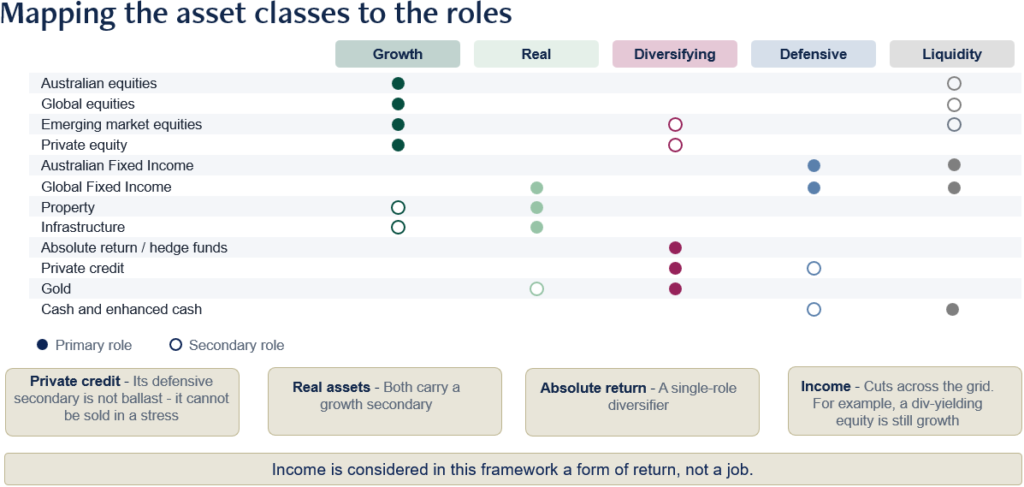
Source: Mason Stevens OCIO / Portfolio Role Framework. Two cells remain IC discussion points: whether private equity earns a diversifying secondary, and whether gold’s primary role is diversifying or real.
This approach helps advisers assess whether portfolios are genuinely diversified or merely appear diversified on paper.
For example, private credit may provide attractive income and diversification benefits, but it does not necessarily provide liquidity during periods of stress. Infrastructure whilst classified typically as a growth asset, its role in the portfolio is a focus on real return, provide some inflation ballast.
Understanding the distinction across roles becomes increasingly important as portfolios incorporate a broader opportunity set.
The coming wealth transfer will raise expectations
The investment landscape is evolving at the same time that Australia undergoes one of the largest intergenerational wealth transfers in its history.
Estimates suggest between $3.5 trillion and $5.4 trillion could transfer from Baby Boomers to younger generations over coming decades.4 5
This next generation of wealth holders has different expectations:
- Greater transparency
- More direct engagement
- Digital-first experiences
- Broader exposure to alternatives
- Increased interest in thematic investing
As a result, adviser value propositions are also evolving.
Clients increasingly seek not just product recommendations, but portfolio oversight, governance, education and strategic decision-making. They are seeking conviction and comfort that their portfolios are resilient to shocks and a wider distribution of potential outcomes, as well as a readiness to act and make robust decisions.
The adviser opportunity
The key takeaway for advisers:
The future may be more complex, but it also offers a wide opportunity set to build resilient portfolios.
Shocks are likely to remain frequent. Markets will continue to surprise. Correlations will continue to change.
The advantage will belong not to those who can predict every shock, but to those who build portfolios capable of surviving them and acting when opportunities emerge.
In the new normal, resilience is no longer simply a risk-management exercise – it is becoming a competitive investment advantage.
Footnotes
- Mason Stevens OCIO, Don’t Be Shocked by Shocks: Portfolio Resilience and Opportunity in the New Normal, July 2026.
- Nuveen, 2026 EQuilibrium Global Institutional Investor Survey, February 2026.
- McKinsey & Company, Global Private Markets Report 2025.
- Grant Thornton Australia, Preparing the Next Generation for Australia’s Largest Wealth Transition, September 2024.
- RSM Australia, The Big Wealth Transfer, March 2026
To find out more about how we can help you grow and scale your wealth practice, visit: https://masonstevens.com.au/growth-engine/ or contact us here.



